
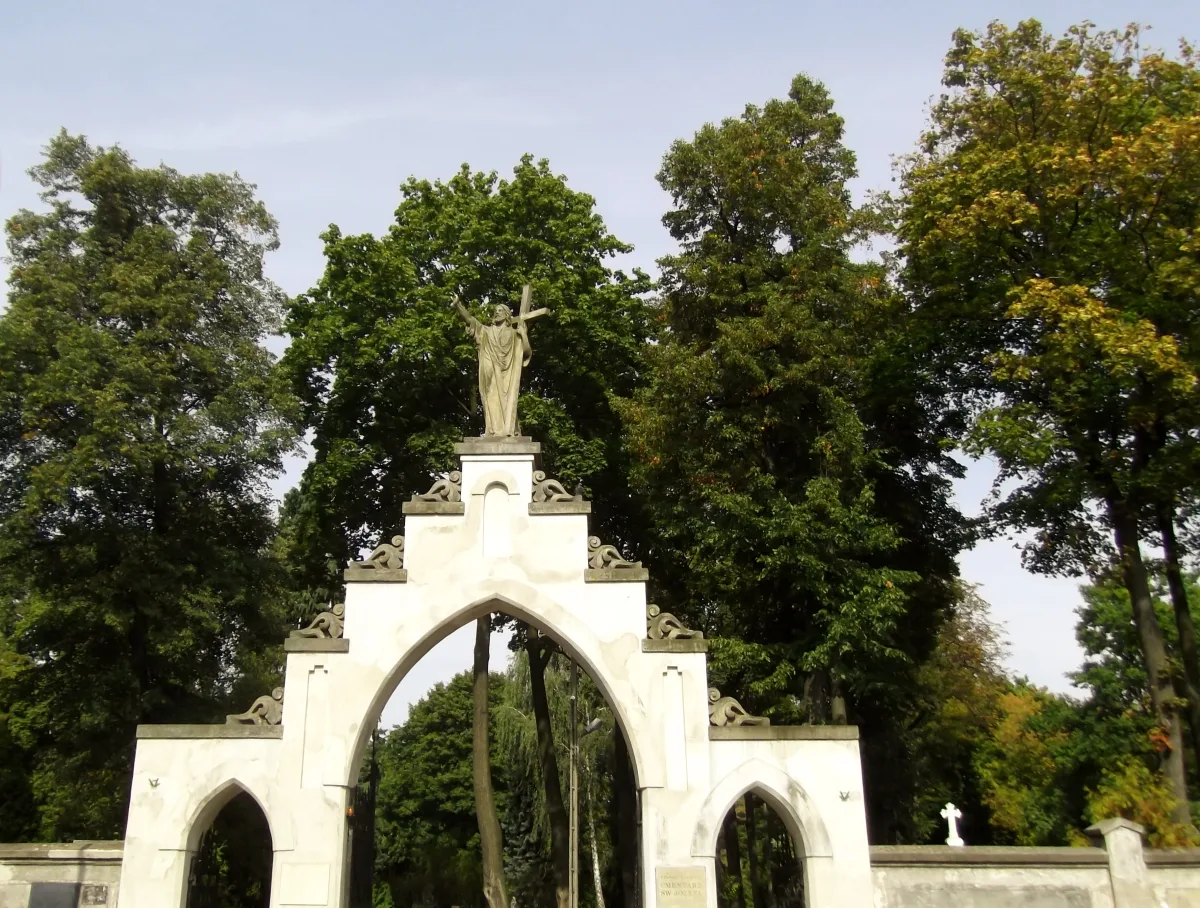
On the corner of Ogrodowa and Srebrzyńska streets in Łódź lies one of the most telling witnesses to the city's multicultural history: Cmentarz Stary, founded between 1855 and 1858 as a shared, though internally divided, necropolis for the three religious communities of the then rapidly growing Łódź.
A city of four cultures needed room for three cemeteries
By the mid-19th century Łódź was already a city where Poles, Germans, Jews and Russians lived side by side, hence the popular description today of a "city of four cultures". When the authorities decided to establish a new, large necropolis on Ogrodowa Street, it was divided into three parts corresponding to the city's three main Christian denominations: Catholic, Augsburg Evangelical and Orthodox. The fourth community, the Jewish one, buried its dead separately, in its own, distinct cemetery, known today as the Jewish Cemetery, one of the largest in Europe.
The Catholic section - eleven hectares
The largest, Catholic part of Cmentarz Stary covers 11 hectares and is dedicated to All Saints. Here rest many of the townspeople and workers of old Łódź, as well as some of the Catholic factory-owning families. A walk along the alleys of this part of the cemetery lets you trace how gravestone fashion changed over a century and a half, from modest classicist slabs to richly decorated 19th-century monuments.
The Protestant section - mausoleums of the factory owners
The nine-hectare Augsburg Evangelical section is the resting place of many of old Łódź's most important industrial families. The section's biggest attraction is the neo-Gothic Scheibler Family Chapel, completed in 1888 to a design by Edward Lilpop and Józef Dziekoński, regarded as one of the greatest works of cemetery architecture in the world. It holds the grave of Karol Scheibler and his sons, and other family members were buried there in later years. Nearby stands the equally impressive Heinzel mausoleum from the turn of the 19th and 20th centuries. It is in this part of Cmentarz Stary that the scale of the fortunes built by the German factory owners who settled in Łódź from the mid-19th century onward, and how they wished to be remembered after death, is best seen.
The Orthodox section - a trace of Russian administration
The smallest section, covering less than a hectare, is the Orthodox one, holding mainly the graves of Russian officials and soldiers connected with the tsarist administration of the Kingdom of Poland, of which Łódź was then a part. It is a discreet but clear reminder that the city functioned under Russian rule for decades, and that the Russian presence was not limited to the military garrison.
A Historic Monument since 2015
Cmentarz Stary is one of the most important sepulchral sites in Łódź. In 2015 the whole complex was recognised as a Historic Monument (Pomnik Historii), one of the highest forms of heritage protection in Poland. Nearly 200 gravestones from this necropolis are listed in the voivodeship's register of monuments. Since 1995, every All Saints' Day in November, a fundraiser has been held for the restoration of monuments damaged by time, an initiative that has helped save many valuable 19th-century tombs from total ruin.
In practice: how to visit
Cmentarz Stary lies on the corner of Ogrodowa and Srebrzyńska streets, within easy walking distance of both the centre of Łódź and Manufaktura. Admission to all three sections is free, and the cemetery is open daily during daylight hours that follow the season. It is worth setting aside at least an hour for a walk through all three sections, and lovers of cemetery architecture should plan more time at the Scheibler and Heinzel mausoleums in the Protestant section. More historical routes around Łódź can be found in the Poznaj Łódź (Discover Łódź) section.
Be the first! Add a comment.
You need to log in to add a comment.
Log in